Hi this is Team Merchant Navy Decoded !!!
Please fill the below form with your query and we will get back to you in next 12 hours.
Rest assured your data is safe with us !!!🙂
Ask Your Query| For Beginner | For Professional |
|---|---|
| GME | Engine Side |
| G.P. Rating | Deck Side |
| ETO | G.P. Rating |
| IMUCET & Sponsorship | Combo Offers |
| Free Course | MEO |
| Free Course |
| For Beginner | For Professional |
|---|---|
| GME | Engine Side |
| G.P. Rating | Deck Side |
| ETO | G.P. Rating |
| IMUCET & Sponsorship | Combo Offers |
| Free Course | MEO |
| Free Course |
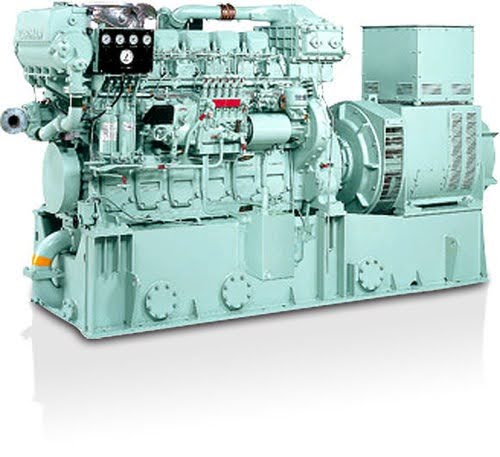
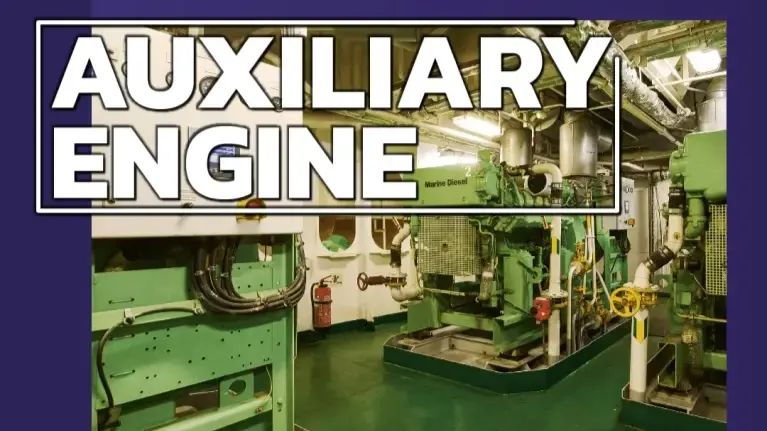
An auxiliary engine onboard a ship is smaller than the main engine, which is used to provide power for various essential functions other than propulsion.
The main engine drives the ship’s propeller and auxiliary engines generate electricity to power essential systems like lighting, air conditioning (HVAC), navigation equipment (bridge equipment), communication devices, pumps, and other machinery required for the safe and efficient operation of the ship.
Generation of Electricity
Distribution of Electricity:
If you find auxiliary engines a difficult topic to tackle, then fret not, we have just the right package for you that will help you to clear all your concepts of auxiliary engines.
Forget complicated theory for a second.
Think of it like this:
The system removes heat from inside the cold room and throws it outside.
It does this using a cycle:
And this cycle keeps repeating.
The synchroscope visually indicates when the generators’ frequencies are aligned, while the three-bulb method provides a simpler, emergency solution by observing the brightness of three light bulbs connected to the generator terminals.
Proper synchronization prevents electrical imbalances, reduces equipment wear, and ensures a reliable power supply, making it a critical procedure for shipboard power management.
To successfully synchronize generators, the following conditions must be met:
A blackout situation on a ship is a complete loss of electrical power across all systems, including propulsion, navigation, and safety equipment.
Blackout can occur due to a failure in the power generation system, such as generator malfunction or fuel shortages, or due to a fault in the power distribution system.
During a blackout, the ship becomes unable to operate its essential systems, posing serious risks to safety and navigation. During Blackout immediate measures, including emergency power systems and manual control, are critical to restore power and ensure the ship’s safety and operational integrity.
In case of a blackout, follow these steps and precautions:
Note that this procedure is not generally followed on Unattended Machinery Space (UMS) ships but is common in manned engine rooms.
2. Manual Stop:
The purpose of a marine auxiliary engine is to provide electrical power and hydraulic power for the ship’s various systems and equipment. These systems can include:
Auxiliary engines are used to generate electricity for lighting, communication, navigation, and other essential systems.

Auxiliary engines are also used to power the various pumps on the ship, including bilge pumps, fire pumps, and ballast pumps.

Auxiliary engines provide power to the heating, ventilation, and air conditioning (HVAC) systems on the ship.

Auxiliary engines can also provide power for other equipment on the ship, such as cranes, winches, and other machinery.


Four-stroke engines are commonly used as auxiliary engines on ships instead of two-stroke engines for several reasons:
Four-stroke engines are more flexible in terms of their power output and can be adapted to different power requirements. This makes them suitable for use as auxiliary engines on ships, where power demands can vary widely.
Four-stroke engines are generally more fuel efficient than two-stroke engines at low and medium loads, which is where auxiliary engines typically operate. This means that they can help to reduce the operating costs of a ship.
Transformers may be used to step down or step up the voltage for certain equipment that requires lower voltage or higher voltage, such as lighting (220V or 110V systems).
AC 3 Phase power is preferred onboard over DC because it gives more power for the same size of wire, it delivers more power efficiently, ensures a constant and smooth power flow, improves motor performance, and balances the load better.
Disclaimer :- The opinions expressed in this article belong solely to the author and may not necessarily reflect those of Merchant Navy Decoded. We cannot guarantee the accuracy of the information provided and disclaim any responsibility for it. Data and visuals used are sourced from publicly available information and may not be authenticated by any regulatory body. Reviews and comments appearing on our blogs represent the opinions of individuals and do not necessarily reflect the views of Merchant Navy Decoded. We are not responsible for any loss or damage resulting from reliance on these reviews or comments.
Reproduction, copying, sharing, or use of the article or images in any form is strictly prohibited without prior permission from both the author and Merchant Navy Decoded.
Decoded Discount Alert! up to 50% OFF
Use Coupon Code Deep50